
Year 4 · Science
Solids, Liquids and Gases: Year 4 Activities
Sort and explain familiar materials
Choose the state using an observable property. Something that pours is not automatically a liquid.
What do children learn about solids, liquids and gases in KS2?
In Year 4, children learn to group materials as solids, liquids or gases, observe what happens when materials are heated or cooled (melting, freezing, evaporating, condensing), and measure the temperatures at which changes happen — including the water cycle's evaporation and condensation.
What your child should be able to do by the end of the unit
- Sort everyday materials into solid, liquid or gas — and explain the tricky ones (sand pours but is a solid; steam is water as a gas).
- Name the changes of state: melting, freezing, evaporating and condensing.
- Explain the water cycle using evaporation and condensation.
- Read a thermometer and connect temperature to changes of state.
Keep practising: Use the Year 4 Science checklist · Read the Year 4 parent guide
Understand the key idea
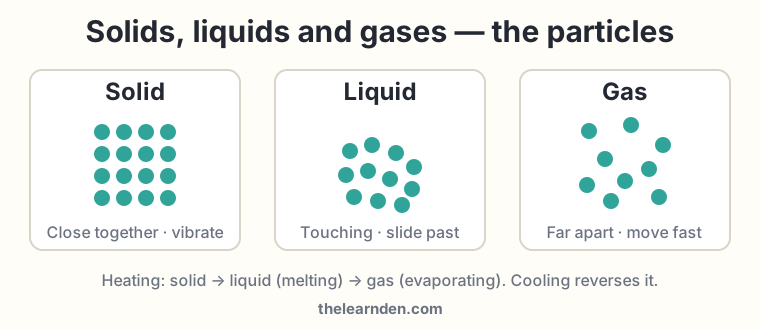
States of matter Year 4 learning compares solids, liquids and gases. Solids keep their shape and volume, liquids keep their volume but flow to fit a container, and gases spread to fill the available space. Heating and cooling can change a material from one state to another.
Properties of solids, liquids and gases in Year 4
When a pupil searches for the properties of solid liquid and gas materials, the most useful comparison starts with shape and volume. A solid normally keeps both. It may bend, stretch or be squashed, but it does not flow to take the shape of a container. A liquid has a fixed volume but no fixed shape: it flows, forms a pool rather than a pile and takes the shape of the lower part of its container. A gas has neither a fixed shape nor a fixed volume. It spreads out and can escape from an unsealed container.
Gases are often invisible, but they are still matter. Air inside a balloon, syringe or upturned cup occupies space and has mass. This is why an apparently empty container is not truly empty. The checked activities below use exact Year 4 lessons and printable practice to help pupils describe these properties before moving to more difficult examples.
- Solid: fixed shape and fixed volume.
- Liquid: no fixed shape, fixed volume and able to flow.
- Gas: no fixed shape or volume and spreads through available space.
Classifying tricky solids, liquids and gases KS2 examples
Some materials can mislead pupils if classification is based only on whether something pours. Sand, rice, flour and sugar can be poured, but each sample is a collection of tiny solid grains. A pile changes its overall outline because the grains move around, not because each grain has become a liquid. A sponge is also a solid even though it can change shape when squeezed, because it has its own structure and does not flow to fill a container.
The strongest answer names an observation and links it to a property. Instead of saying “water is a liquid because it is wet”, say that water keeps its volume but takes the shape of the bottom of each container. Instead of saying “air is a gas because it cannot be seen”, show that trapped air occupies space and can be compressed. Comparing and grouping materials in this way builds the evidence language expected in Year 4 science.
Changing state through heating and cooling
A substance can change state while remaining the same material. Melting happens when heating changes a solid into a liquid. Freezing happens when cooling changes a liquid into a solid. Evaporation happens when particles leave the surface of a liquid and form a gas. Condensation is the reverse change, when a gas cools and becomes a liquid. Water makes these changes easy to connect: ice, liquid water and water vapour are different states of the same substance.
Year 4 pupils should observe that different materials change state at different temperatures and record temperatures in degrees Celsius when appropriate. A safe investigation can compare ice cubes placed in different locations, measure how long they take to melt and keep cube size, container and timing method the same. The purpose is to link a measured change to heating or cooling, not to handle hot materials without adult supervision.
A simple properties investigation and recording routine
Choose a small set of familiar samples and decide what evidence will separate the three states. For solids, test whether each sample keeps its own shape when moved. For liquids, pour equal measured volumes into differently shaped transparent containers and observe that the surface and outline change while the amount stays the same. For gases, trap air safely in a balloon or sealed syringe and observe that it occupies space. Do not taste materials or heat them without suitable adult control.
Record the material, prediction, observation and conclusion in separate columns. A useful conclusion follows the pattern: “I classify ___ as a ___ because ___.” If an example seems difficult, repeat the test or choose another observable property rather than changing the definition. This routine turns the solids liquids and gases KS2 topic into a fair, evidence-based classification task and prepares pupils for later work on evaporation, condensation and the water cycle.
Common mix-up
A material does not stop being matter when it becomes a gas. Gas still has mass and occupies space even when it cannot be seen.
Try this first
- Describe whether each material keeps its own shape and volume.
- Classify it as a solid, liquid or gas using observable properties.
- Name the change of state caused by heating or cooling.
Ask: Which property tells you that this material is a liquid rather than a solid or gas?
Curriculum check: National curriculum in England: science programmes of study
Read the parent guide to solids, liquids and gases in Year 4
Year 4 learners practise properties of solids liquids and gases.
The activities include Discover the Properties of Liquids and How They Change State, Explore the Properties of Liquids and How They Change State, Identify Solids and Liquids, and related practice. The checked support below includes video, worksheet, lesson, teaching. Open a resource in its provider's website and choose the format that best helps the learner explain the idea independently.
Activities covered
- Discover the Properties of Liquids and How They Change State
- Explore the Properties of Liquids and How They Change State
- Identify Solids and Liquids
- Investigate the Properties of Gases
- Investigate the Properties of Liquids
- Investigate the Properties of Solids and Liquids
- Recognise Properties of Solids and Liquids
- Understand About the Air Around Us
- Understand How to Test for Solids
- Understand the States of Matter: Gas
Share this topic
Send the canonical page to another parent, carer or learner. No personal details are added.
Choose a learning resource
Start with an explanation, then practise, then print. Labels show access and review status before you click.
What the icons and labels mean
Formats
Watch — a video of a teacher explaining it
Learn — a lesson or teaching page to read and work through
Practise — questions or activities to try
Print — a worksheet you can print, usually with answers
Cost and account
Free completely free to use
Free account needed verified free, but the site asks you to create an account first
Subscription part of a paid plan on that site
Check access access has not yet been confirmed, so it appears only under Everything
Review status
Verified match the match passed the full review gate and has a visible check date
Reviewed, not fully verified useful but not yet at the full verification bar
Awaiting review still waiting for review
Tell us how it went
This helped · Link or access problem · Not the right match
Oak National Academy, BBC Bitesize, Corbettmaths and Mathsframe normally open with no account. Twinkl access varies by resource, so we only show a free label after checking the resource's own page. Unconfirmed access appears only under Everything.
Watch it explained
a teacher walks through it
Properties of Solids, Liquids and Gases
Best for: a clear explanation before you practise
Changing State: Liquid to Gas
Best for: a clear explanation before you practise
Changing State: Liquid to Solid
Best for: a clear explanation before you practise
Changing State: Solid to Liquid
Best for: a clear explanation before you practise
Comparing and Grouping Solids, Liquids and Gases
Best for: a clear explanation before you practise
Nothing in this step matches your filters.
Learn it properly
lessons and teaching pages
Year 4 States of Matter: Solid, Liquid or Gas Lesson Pack
Best for: a structured lesson to work through
Year 4 States of Matter Knowledge Organiser
Best for: worked examples and step-by-step teaching
Nothing in this step matches your filters.
Practise it
questions and activities to try
Nothing in this step matches your filters.
Print and finish
worksheets away from the screen
Properties of Solids, Liquids and Gases Lesson Materials
Best for: pencil-and-paper practice away from the screen
Comparing and Grouping States of Matter Lesson Materials
Best for: pencil-and-paper practice away from the screen
KS2 Science: Gases, Liquids and Solids Worksheet
Best for: pencil-and-paper practice away from the screen
Nothing in this step matches your filters.