
Year 9 · Science
Density, Pressure and the Particle Model
Check density and pressure reasoning
Use spacing, particle mass and collisions. Do not say that heating makes each particle grow.
What are the properties of solids, liquids and gases?
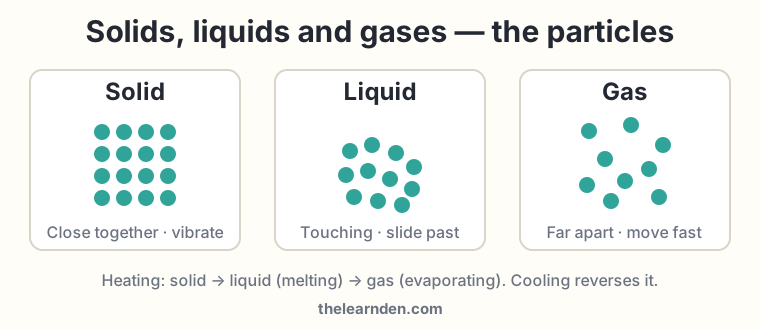
Solids keep a fixed shape and volume because closely packed particles vibrate about fixed positions. Simplified diagrams often show regular rows, but not every solid has a perfectly regular crystalline arrangement. Liquid particles stay close but move past one another. Gas particles are much farther apart, move rapidly and collide with container walls, producing pressure.
| Property | Solid | Liquid | Gas |
|---|---|---|---|
| Shape | Fixed | Takes container's shape | Fills container |
| Volume | Fixed | Fixed | Not fixed |
| Particle arrangement | Closely packed; arrangement may be ordered or disordered | Close together and disordered | Much farther apart |
| Particle movement | Vibrate about fixed positions | Move past each other | Move rapidly in all directions |
| Can be compressed? | No | Barely | Easily |
Keep practising: Review the Year 7 introduction to states of matter · Use the Year 9 Science checklist
Understand the key idea
Solids keep a fixed shape and volume because their particles are closely packed and vibrate about fixed positions. Simplified diagrams often show regular rows, but not every solid has a perfectly regular crystalline arrangement. Liquids keep a fixed volume while their particles move past one another. Gas particles are much farther apart and collide with their container, producing pressure.
What are the properties of a solid?
A solid keeps a fixed shape and a fixed volume. Its particles are packed closely together in a regular or irregular arrangement and vibrate around fixed positions. Strong attractions between nearby particles make it difficult for them to move past one another, which is why a solid does not flow and is very difficult to compress.
The particle model also explains why many solids expand slightly when heated. The particles gain energy and vibrate more, increasing their average separation a little. The particles themselves do not swell, melt or disappear.
How liquids and gases compare
A liquid has a fixed volume but takes the shape of its container. Its particles remain close together, so a liquid is hard to compress, but they can move past one another, so it can flow. A gas has no fixed shape or volume. Gas particles are much farther apart and move rapidly in random directions, spreading until they fill the available container.
The large spaces between gas particles make gases compressible. They also explain why a gas has a much lower density than the same substance as a liquid or solid. Pressure is produced when moving gas particles collide with the walls of their container.
- Solid: fixed shape, fixed volume, does not flow, almost incompressible.
- Liquid: container's shape, fixed volume, flows, almost incompressible.
- Gas: container's shape and volume, flows, compressible.
Using energy to explain changes of state
Heating transfers energy to a substance. Its particles move or vibrate more, and at the melting or boiling point they can overcome enough attraction to change state. Cooling transfers energy away, so particle movement decreases and attractions can hold the particles closer together again. These are physical changes: the substance is still made from the same type of particle before and after the change.
Density, pressure and the limits of particle diagrams
Density is mass divided by volume, so it depends on both the substance and its state. For the same substance, the gas state is normally much less dense because the same mass is spread through a much larger volume. A denser material is not automatically a solid, and different solids can have very different densities.
Gas pressure comes from moving particles colliding with container walls. Raising the temperature increases their average kinetic energy, so collisions are usually more frequent and more forceful. Compressing a gas into a smaller volume also increases collision frequency. Particle diagrams support this explanation, but their dots are not literal pictures, sizes or scale distances, and an ordered solid diagram represents one model rather than every solid structure.
Common mix-up
Heating does not make each particle grow. It increases particle movement and can increase the spacing between particles.
Try this first
- Compare shape, volume and compressibility for each state.
- Draw a particle diagram for a solid, liquid and gas.
- Use particle arrangement and movement to explain each observed property.
Ask: Why can a gas be compressed much more easily than a liquid?
Curriculum check: National curriculum: science programmes of study
Year 9 learners practise particle arrangement in solids liquids and gases.
The activities include Explore the Arrangement of Particles in Solids, Liquids and Gases, Investigate the Arrangement of Particles in Solids, Liquids and Gases, Investigate the Properties of Solids, Liquids and Gases, and related practice. The checked support below includes worksheet, teaching, lesson, video. Open a resource in its provider's website and choose the format that best helps the learner explain the idea independently.
Activities covered
- Explore the Arrangement of Particles in Solids, Liquids and Gases
- Investigate the Arrangement of Particles in Solids, Liquids and Gases
- Investigate the Properties of Solids, Liquids and Gases
- Learn About the Properties of Liquids and Gases
- Understand the Arrangement of Particles in the Three States of Matter
- Understand the Properties of Solids, Liquids and Gases
Share this topic
Send the canonical page to another parent, carer or learner. No personal details are added.
Choose a learning resource
Start with an explanation, then practise, then print. Labels show access and review status before you click.
What the icons and labels mean
Formats
Watch — a video of a teacher explaining it
Learn — a lesson or teaching page to read and work through
Practise — questions or activities to try
Print — a worksheet you can print, usually with answers
Cost and account
Free completely free to use
Free account needed verified free, but the site asks you to create an account first
Subscription part of a paid plan on that site
Check access access has not yet been confirmed, so it appears only under Everything
Review status
Verified match the match passed the full review gate and has a visible check date
Reviewed, not fully verified useful but not yet at the full verification bar
Awaiting review still waiting for review
Tell us how it went
This helped · Link or access problem · Not the right match
Oak National Academy, BBC Bitesize, Corbettmaths and Mathsframe normally open with no account. Twinkl access varies by resource, so we only show a free label after checking the resource's own page. Unconfirmed access appears only under Everything.
Watch it explained
a teacher walks through it
States Of Matter - Solids, Liquids & Gases | Properties of Matter | Chemistry | FuseSchool
Best for: a clear explanation before you practise
Properties of Solids, Liquids and Gases
Best for: a clear explanation before you practise
Nothing in this step matches your filters.
Learn it properly
lessons and teaching pages
Solid, liquid, gas states and changes of state: lesson sequence
Best for: worked examples and step-by-step teaching
Nothing in this step matches your filters.
Practise it
questions and activities to try
Nothing in this step matches your filters.
Print and finish
worksheets away from the screen
Solids, liquids and gases - KS3 Physics
Best for: pencil-and-paper practice away from the screen
Nothing in this step matches your filters.