
Year 7 · Science
Energy transfer diagrams and energy stores
What is an energy transfer diagram?
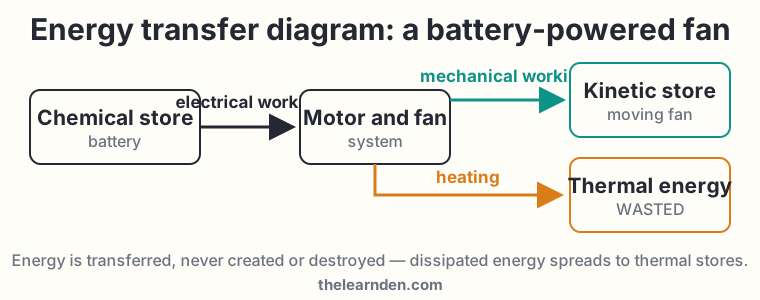
An energy transfer diagram identifies the starting and ending energy stores and labels the transfer pathway between them. In a battery-powered fan, the battery's chemical store decreases. Energy is transferred electrically to the fan's kinetic store, with some transferred by heating to the thermal store of the surroundings.
How to draw one in three steps
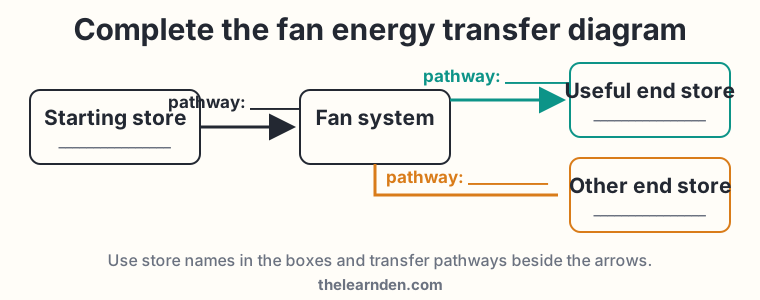
- Name the energy store at the start (for example, chemical energy in a battery).
- Draw an arrow for each transfer and label the pathway, such as electrical working or heating.
- Mark each end store useful or wasted; wasted energy usually spreads to the thermal store of the surroundings.
Keep practising: Open the blank fan diagram · Use the Year 7 Science checklist
Understand the key idea
Energy is held in stores such as kinetic, gravitational, thermal, chemical and elastic. It is shifted between stores by pathways: mechanical working, electrical working, heating, and radiation. Energy is never used up or made — the total is conserved, though some energy is always dissipated to the surroundings and becomes less useful.
What does 'changes in energy' mean?
Scientists describe energy changes by identifying energy stores before and after an event. A moving object has a kinetic energy store; a raised object has a gravitational potential energy store; a stretched spring has an elastic energy store; fuels, foods and batteries have chemical energy stores; and warm objects have thermal energy stores.
The pathway explains how energy moves between those stores. A force can transfer energy mechanically, an electric current can transfer it electrically, and a temperature difference can transfer it by heating. Light, infrared and other waves transfer energy by radiation.
Examples of energy changes
When a cyclist speeds up, energy is transferred from a chemical store in the rider's body to the kinetic stores of the bicycle and rider. When a ball falls, its gravitational potential store decreases while its kinetic store increases. When bicycle brakes slow a wheel, energy is transferred mechanically from the wheel's kinetic store and by heating to thermal stores in the brakes and surroundings.
Real processes are not perfectly efficient. Friction, air resistance and electrical resistance transfer some energy to thermal stores in the surroundings. That energy still exists, but because it is spread out it is usually harder to use again.
Three energy-store and pathway questions
- An electric kettle is used to heat water. Name the pathways and the store that increases. Answer: Energy is transferred electrically to the kettle's heating element and then by heating to the water. The energy in the water's thermal store increases.
- A wind-up toy car is released and speeds across the floor. Describe the transfer using stores and pathways. Answer: The spring's elastic store decreases. Energy is transferred mechanically to the car's kinetic store, with some transferred by heating to the thermal stores of the car, floor and surroundings.
- Why is it wrong to say a lamp ‘turns electricity into light energy’? Answer: It is wrong because light is not an energy store. The lamp is supplied electrically. Some energy is transferred away by visible electromagnetic radiation and some by heating. Ultimately the transferred energy increases thermal stores in the surroundings.
Common mix-up
There is no such thing as "sound energy" or "light energy" as a store. Sound and light are pathways that shift energy between stores, and calling them stores makes energy diagrams wrong.
Try this first
- Name the start and end store for a falling ball.
- Describe the pathway when bicycle brakes warm up.
- Explain what "wasted" energy means if energy is always conserved.
Ask: If energy is never destroyed, why do we talk about wasting it?
Curriculum check: National curriculum: science programmes of study
Year 7 learners practise energy changes and energy efficiency explained.
The activities include Describe Energy Changes, Explore Energy Changes, Find Out About Energy Changes, and related practice. The checked support below includes video, teaching, lesson, worksheet. Open a resource in its provider's website and choose the format that best helps the learner explain the idea independently.
Activities covered
- Describe Energy Changes
- Explore Energy Changes
- Find Out About Energy Changes
- Identify Energy Changes
- Identify Forms of Energy
- Investigate Energy Changes
- Understand Energy Changes
- Understand Energy Efficiency
Share this topic
Send the canonical page to another parent, carer or learner. No personal details are added.
Choose a learning resource
Start with an explanation, then practise, then print. Labels show access and review status before you click.
What the icons and labels mean
Formats
Watch — a video of a teacher explaining it
Learn — a lesson or teaching page to read and work through
Practise — questions or activities to try
Print — a worksheet you can print, usually with answers
Cost and account
Free completely free to use
Free account needed verified free, but the site asks you to create an account first
Subscription part of a paid plan on that site
Check access access has not yet been confirmed, so it appears only under Everything
Review status
Verified match the match passed the full review gate and has a visible check date
Reviewed, not fully verified useful but not yet at the full verification bar
Awaiting review still waiting for review
Tell us how it went
This helped · Link or access problem · Not the right match
Oak National Academy, BBC Bitesize, Corbettmaths and Mathsframe normally open with no account. Twinkl access varies by resource, so we only show a free label after checking the resource's own page. Unconfirmed access appears only under Everything.
Watch it explained
a teacher walks through it
Energy in the home - Energy
Best for: a clear explanation before you practise
Energy stores - Energy
Best for: a clear explanation before you practise
Nothing in this step matches your filters.
Learn it properly
lessons and teaching pages
Oak lesson slides: Energy
Best for: worked examples and step-by-step teaching
KS3 Energy Changes and Transfers: Energy Stores and Transfers Lesson Pack
Best for: a structured lesson to work through
Oak lesson slides: Transferring Energy
Best for: worked examples and step-by-step teaching
Energy Stores and Transfer Pathways Resource Pack
Best for: a structured lesson to work through
Oak lesson slides: Heating And Cooling Our School Sustainably
Best for: worked examples and step-by-step teaching
Nothing in this step matches your filters.
Practise it
questions and activities to try
Nothing in this step matches your filters.
Print and finish
worksheets away from the screen
Energy Transfer Diagrams Worksheet
Best for: pencil-and-paper practice away from the screen
Oak worksheet: Transferring Energy
Best for: pencil-and-paper practice away from the screen
Oak worksheet: Energy
Best for: pencil-and-paper practice away from the screen
Energy Stores and Transfers Worksheet
Best for: pencil-and-paper practice away from the screen
Oak worksheet: Heating And Cooling Our School Sustainably
Best for: pencil-and-paper practice away from the screen
Energy Transfer Diagrams and Efficiency Worksheet
Best for: pencil-and-paper practice away from the screen
Nothing in this step matches your filters.