
Year 7 · Science
Changes of state with the particle model: Year 7
What changes when a substance changes state?
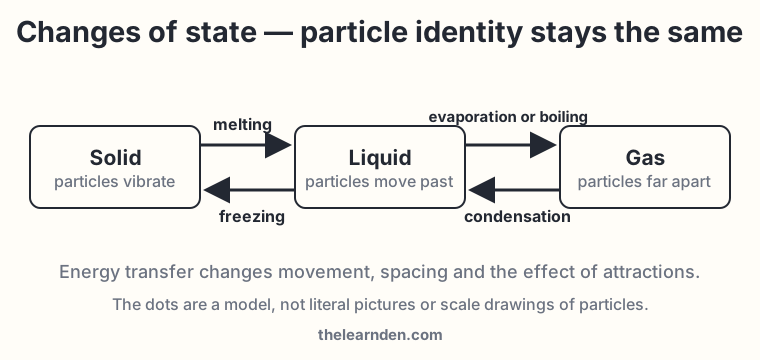
A change of state is a physical change. The particles keep the same identity, while energy transfer changes their movement, spacing and the effect of attractions between them. The model is useful for explaining patterns, but the dots are not literal pictures of particles and their spacing is not drawn to scale.
| Feature | Evaporation | Boiling |
|---|---|---|
| Where it happens | At the liquid surface | Throughout the liquid |
| Temperature | Can happen below the boiling point | Happens at the boiling point for the given pressure |
| What particles do | Some surface particles escape | Gas bubbles form throughout the liquid |
Keep practising: Use the Year 7 Science checklist
Understand the key idea
Melting, freezing, boiling and condensing are physical changes. The substance keeps the same particles, but energy transfer changes how quickly those particles move and how strongly they are held together.
Model answer: explain what happens when water boils
The particles gain energy and move faster. When enough particles have enough energy to overcome the attractions holding them together, bubbles of water vapour form throughout the liquid, not only at the surface. The bubbles contain water vapour, not air, and the particles remain water particles: they do not change identity. This is the throughout-the-liquid distinction shown in the evaporation and boiling comparison above.
Common mix-up
Particles do not disappear or become a new substance during a change of state.
Try this first
- Name the starting and finishing states.
- Decide whether energy is transferred into or out of the substance.
- Describe how particle movement, spacing and attraction change.
Ask: What stays the same when ice melts, and what changes?
Year 7 learners practise melting freezing boiling and condensing explained.
The activities include Compare Chemical and Physical Changes, Recognise Changes of State: Freezing and Condensing, Recognise Changes of State: Melting and Boiling, and related practice. The checked support below includes video, teaching, worksheet, lesson. Open a resource in its provider's website and choose the format that best helps the learner explain the idea independently.
Activities covered
- Compare Chemical and Physical Changes
- Recognise Changes of State: Freezing and Condensing
- Recognise Changes of State: Melting and Boiling
- Understand Changes of State and Forces of Attraction
- Understand The Movement of Particles in Changes of State
Share this topic
Send the canonical page to another parent, carer or learner. No personal details are added.
Choose a learning resource
Start with an explanation, then practise, then print. Labels show access and review status before you click.
What the icons and labels mean
Formats
Watch — a video of a teacher explaining it
Learn — a lesson or teaching page to read and work through
Practise — questions or activities to try
Print — a worksheet you can print, usually with answers
Cost and account
Free completely free to use
Free account needed verified free, but the site asks you to create an account first
Subscription part of a paid plan on that site
Check access access has not yet been confirmed, so it appears only under Everything
Review status
Verified match the match passed the full review gate and has a visible check date
Reviewed, not fully verified useful but not yet at the full verification bar
Awaiting review still waiting for review
Tell us how it went
This helped · Link or access problem · Not the right match
Oak National Academy, BBC Bitesize, Corbettmaths and Mathsframe normally open with no account. Twinkl access varies by resource, so we only show a free label after checking the resource's own page. Unconfirmed access appears only under Everything.
Watch it explained
a teacher walks through it
What is a chemical reaction?
Best for: a clear explanation before you practise
Changes of state
Best for: a clear explanation before you practise
Oak lesson video: Changes of state, energy and evaporation
Best for: a clear explanation before you practise
Melting Particle Model
Best for: a clear explanation before you practise
Changes of State
Best for: a clear explanation before you practise
Nothing in this step matches your filters.
Learn it properly
lessons and teaching pages
KS3 Chemical Reactions Lesson 1: Characteristics of Chemical Reactions Lesson Pack
Best for: a structured lesson to work through
Melting: melting points and freezing points
Best for: worked examples and step-by-step teaching
Boiling and condensing
Best for: worked examples and step-by-step teaching
Nothing in this step matches your filters.
Practise it
questions and activities to try
Nothing in this step matches your filters.
Print and finish
worksheets away from the screen
Oak worksheet: Characteristics Of Chemical Reactions
Best for: pencil-and-paper practice away from the screen
Physical or Chemical Change Match and Draw
Best for: pencil-and-paper practice away from the screen
Changing State Worksheet
Best for: pencil-and-paper practice away from the screen
Temperature and Changing State Worksheet
Best for: pencil-and-paper practice away from the screen
Changes of State Illustration Sheet
Best for: pencil-and-paper practice away from the screen
Nothing in this step matches your filters.